Published on 14.09.2026 by ms
Since 1 July 2026, a number of changes have been in effect in Switzerland that affect both private motorists and some professional drivers. This article also covers a change that will not come into force until next year and should be of particular interest to anyone planning to obtain a driving licence in 2027.
Partial revision of the Road Signs and Signals Ordinance
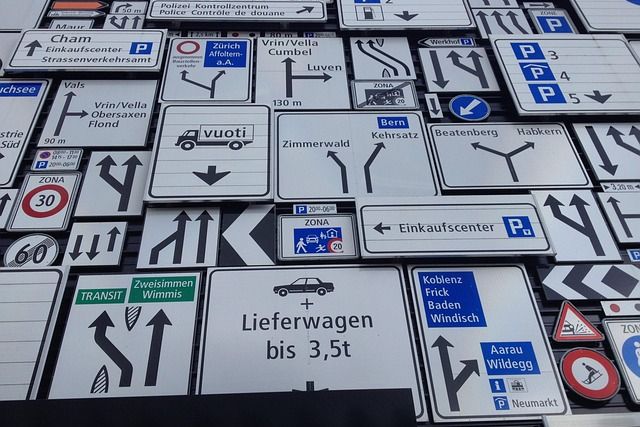
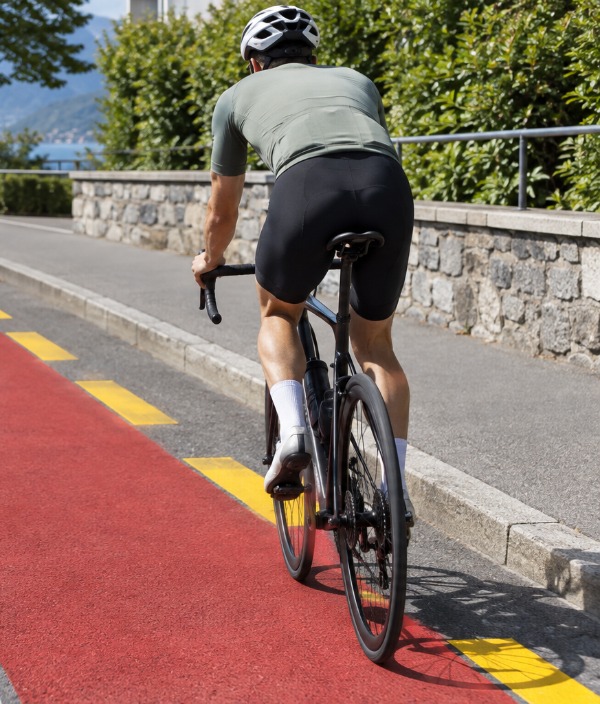 One aspect of the new regulations concerns road signs and markings. The partial revision of the Road Signs and Signals Ordinance came into force on 1 July 2026 and introduces greater standardisation: new direction signs are being introduced, with cyclists in particular benefiting from the changes. For example, cycle lanes at hazardous locations are now marked in red.
Markings in 30 km/h zones are also becoming more standardised, and bilingual place names on motorway signs are now subject to uniform rules as well.
This means that, since 1 July 2026, the numerals painted on the road to indicate 30 km/h zones have been regulated uniformly throughout Switzerland in terms of their shape, size and placement, rather than differing from one canton or municipality to another as they did previously. With regard to place names on motorway signs, cantons or municipalities may submit an application to the Federal Roads Office (FEDRO) for bilingual signage if the smaller language group accounts for at least 30% of the population of the locality concerned. If a municipality submits the application, the approval of the respective canton is also required.
In addition to bilingual place names, the new ordinance also standardises the numbers and names of motorway junctions, the numbering of cantonal motorways, as well as the order and number of items of information displayed on direction signs. Previously, these areas were covered only by less binding technical standards and directives.
 Charging spaces for electric cars are now uniformly marked in green.
Speaking of motorways: since 1 July 2026, anyone who illegally overtakes on the right on a motorway is subject to an on-the-spot fine of CHF 200 instead of being reported for a criminal offence as was previously the case. Overtaking on the right on main roads is now subject to a fine of CHF 140, while incorrectly passing a traffic island now costs CHF 100.
Passing a vehicle on the right is permitted provided you do not subsequently change lanes.
Changes to the road traffic awareness course
This course teaches you how to deal more effectively with hazards on the road and how to better assess your own ability to drive. Until now, the road traffic awareness course took place only after the theory test. From 1 January 2027, this will change: completing the road traffic awareness course will become a prerequisite for registering for the car theory test. This also applies to categories A and A1.
Since 2022, new regulations have made certain driver assistance systems mandatory for newly registered vehicles. As a result of these regulations in the EU and Switzerland, and because these technologies are playing an increasingly important role in driving, driver assistance systems and automated driving systems will become part of the training provided in the road traffic awareness course from 1 January 2027 and will also form part of the theory test. The new test questions on assistance systems approved by the Road Traffic Office are already included in e.driver.
International road transport
 There are also changes for those who drive heavy motor vehicles professionally, although not everyone is affected:
Since 1 July 2026, vehicles and combinations of vehicles over 2.5 tonnes have been subject to ARV 1 if the driver spends more than half of their working time driving. This also means that these vehicles are subject to the requirement to use a tachograph. However, the new regulations apply only to international road transport. Nothing changes for those who use these vehicles exclusively within Switzerland.
Another point to note concerns the transport of competition horses within the EU where the operating weight exceeds 2.5 tonnes. If such transport is carried out on behalf of a third party, for example a sports club, it is considered commercial transport and is subject to ARV 1 abroad, unless stricter requirements have been agreed.